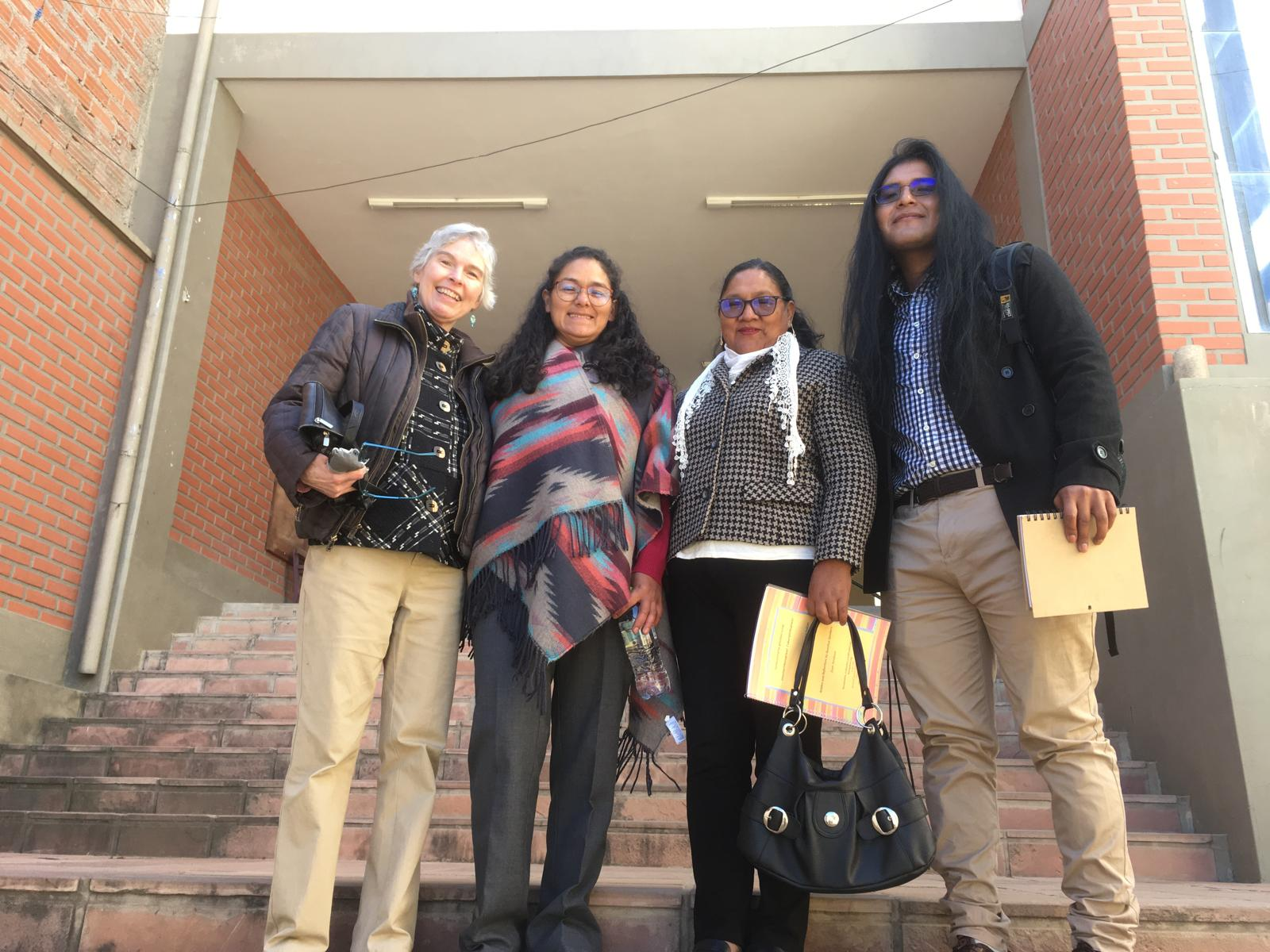
The Universidad Mayor de San Francisco Xavier, founded in 1624, is the nearest public university to residents of the small communities surrounding Tarabuco municipality. It is also Carlos Flores Quispe’s alma mater; he grew up in a farming and weaving community a few hours away. Carlos, María del Carmen Bolívar and I gave an invited talk at the University for students and faculty of the Language department on July 24.
Initially we feared we would have a small audience since it was the first day back from winter break. But the auditorium quickly filled up and there was standing room only. More than one hundred thirty students and a dozen professors of Quechua, English and French were in attendance.
Our presentation was based on the rural Andean experience of the cycle of cultivation and the fact that we are profoundly nurtured by what we cultivate – a relationship that is at once demanding and rewarding. We urged the audience to continue to care for their own indigenous languages, and we shared the various ways our diverse team has been doing so.
Students wanted to know in what ways learning or re-learning their ancestors’ Quechua language could possibly benefit them. Indifference and outright discrimination are the order of the day; everywhere we go, we hear of parents who opt for their children to speak only Spanish, and teachers who feel that teaching in and about the ancestral indigenous language is an unfair burden.
The three of us spoke from different perspectives about the advantages of knowing the language, rooted in ancient and current lifeways. Our responses must have been convincing, since professors reported that a number of students signed up to study Quechua after the talk.
Some of the elder Quechua experts objected to the way we had spelled certain transcriptions. Ah, the eternal debate over writing systems! It continually generates more heat than light. People get angry when they feel that a particular choice of spelling is an insult to their local dialect or to the integrity of their culture. They seemed satisfied, though, when we pointed out that all of our interview videos have been published online via a non-commercial indigenous language archive, and that anyone is free to produce a new transcription or analysis in the writing system of their choice.
 Yachay Simi (Wise Language)