Category Archives: Uncategorized

Jornada de limpieza – Cleanup Day


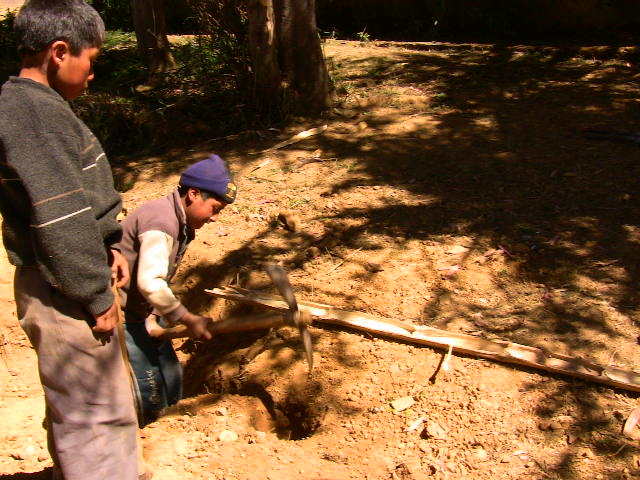
Children dig hole for trash

Written Tuesday, July 20

When I first proposed a natural science project to the teachers at Ccotatóclla, I had some very specific hopes for what the children would be learning. I proposed that each small group lay out a square in the schoolyard, to be marked with stones and wool yarn (easily found here) so that they could develop hypotheses about what lives there, observe everything they found within the square closely, take notes on it in their own language, later to be discussed as a group and connected orally and in writing with local wisdom, and hopefully reinforce and move the local wisdom forward in real time. That is the heart of the scientific method, which we also discussed explicitly in their own language .
I didn’t conceive of this as an outsider’s gift or a case of enlightenment coming to those in the dark. I was thinking of it as a celebration of local knowledge and life. As I presented the idea to various indigenous curriculum designers, each had their own take on the project – the artist, Jaime, for example, thought we should ask local sages about wild animals and domesticated animals – he noted that too often if an animal is wild we see it as a nuisance and do not perceive its role in the spiritual order of things, something that an elder would be more aware of.
When I presented the idea to the local schoolteachers, I cringed when one of them said she would like to add a school cleanup day to these ‘pure’ science and indigenous spiritual activities. When this teacher heard talk of the schoolyard she connected it with her impression of the local people’s ignorance about personal hygiene and waste disposal. She asked me to buy trash cans for the school. She proposed that we make home visits to local farms and instruct people on how to improve their lives. This nearly missionary attitude was exactly what I wanted to avoid. I believe that the most able and alert of the farmers are better qualified than outsiders to consider in what ways their activities are connected to their health.
Nevertheless, there are ways in which local farmers are unprepared to deal with the encroaching industrial world. Pesticides arrive in metal canisters labeled only in Chinese. Things that people buy are increasingly wrapped in plastic bags and containers, which get thrown on the ground just as their organic waste has been dealt with for millenia. There is no public recycling program in Peru’s cities, let alone in the countryside.
I asked my co-worker Martin to address the teachers on the issue of respecting local knowledge and keeping an indigenous Andean perspective rather than adopting a ‘save Mother Earth from the locals’ attitude, or as my friend Hipólito put it, an ‘all Indians are dirty and need to be taught cleanliness’ attitude.
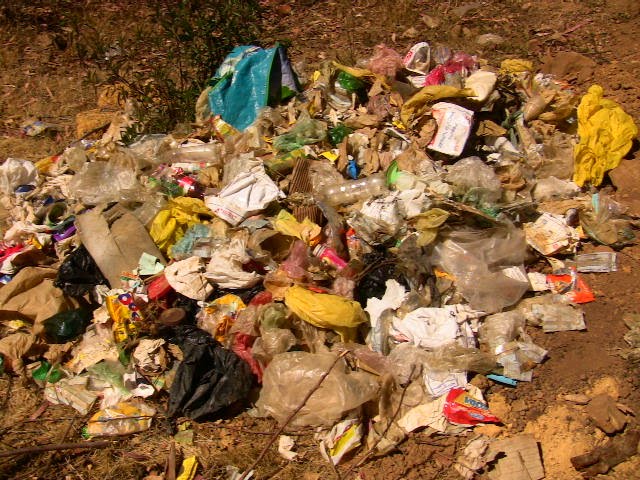
We set Monday as cleanup day and most of the children arrived with plastic bags, rakes and picks. We labeled half of the trash cans ‘plastic’ and half ‘non-plastic’ waste with the idea that we would bury plastics separately. Maybe someday it could be recycled. The rest of the waste would break down. Some of the bigger kids dug two huge holes with Martin in the back, and the rest of us fanned out, picked up trash and dumped it next to the holes. One of the teachers decided to burn piles of eucalyptus leaves in the area where most of the children go to the bathroom. The school has no working outhouses for the children, a political issue which the teachers blame on the parents and the parents blame alternatively on the teachers or on townspeople who have no children.
At the end of the schoolyard is a house where parents take turns preparing hot cereals and soups for school breakfast and lunch. We found lots of tin cans dumped behind this cooking house (right next to the kindergarten. The rest was mostly plastic wrappers and bags, with occasional papers. It took all day, and we had a potato roast at the end, insisting that kids wash their hands with soap. Although some of the kids insisted on tattling if others seemed to be slacking, most kids gave it their all.
Afterwards the teachers and Martin and I had a long lunch, and then Martin took two of us up to a mountaintop to muse about the ancestors and the voices of mountains and trees.

Bathroom talk

Just so you know, here is the bathroom situation in the city and countryside of Cusco.
in the city, you can often find houses with running water and toilets, although toilet seats are not so common.
The Regional Department of Education does not have a bathroom with toilets; it has a room with stalls with holes in the floor. That is in the center of the city.
In the countryside, most houses have outhouses, and even farms now have outhouses, which people don’t bother with when urinating, I am told. I have never seen anyone but myself enter the outhouse at the farm I am staying at.
The school has running water for the teachers and an outhouse with holes in the floor. The children have two non-functioning outhouses and so when we went out in the schoolyard for our experiment, we had to avoid areas with extensive human waste.
Ta da.

Kindness of strangers and friends

I did lose my teacher friends in the crowds in Paucartambo, around midnight. I was feeling a little nauseous, so I left the crowd and went to sit on a step just a block away. Two hours later, I could not find my friends.
I wandered the streets but found no rooms available in hostels or hotels. Took a cup of tea in a cafe, and asked the people if they knew where I could find a room. No rooms, they said. I noticed their mattress rolled up on the floor, explained I had lost my group and wondered if they could rent me a piece of their blanket. ‘There are too many of us’ they said. Finally, as I put my head down on the table one of them said, they thought they knew where I could lie down for the night. They led me to their father’s house and took me up to a room where I lay on a mattress on the floor for the night, complete with coat, hat and shoes because of the cold.
In the morning, a young woman in the next room greeted me and said, ‘I didn’t even hear you come in!’
She didn’t even want to charge me for staying the night, but asked me lots of questions about my work. She just finished a degree in education and wanted to know how to start a non-profit organization. I told her I thought the best way was to work in one and see how it works.
I did find my friends again eventually in the plaza, but lost them in the afternoon and made my way back to Cusco alone on a bus.
It was nice to sleep in a bed with sheets at Mary Carmen’s house, and she even gave me a hot water bottle for my sore muscles.

Festival at Paucartambo, religious musings

Thursday was the entrada of the festival of the Virgin Little Mother Carmen in Paucartambo. Since this is a festival attended by thousands of tourists and described on the web, I will limit my experiences to brief observations and religious musings.
Paucartambo is a little town on the banks of a big river running through the high mountains. There is a bridge over the river, built in the colonial era.
Groups of men, groups of women, and some mixed groups dress in elaborate costumes representing and making fun of the Spaniards, African slaves, indigenous people and a handful of other characters. They have bands with traditional and modern brass instruments, songs with two part harmonies, and complex dances which they parade through the streets in costume (and later again in street clothes, without masks.)
Thursday night they all parade to the Catholic church to present their songs and dances to the Virgin which sits in the church; a lovely white-skinned porcelain doll dressed in what looks like a wedding dress and surrounded by flowers and other dolls. Nested in the walls of the church are other white-skinned statues representing various saints and religious figures, many of whom seemed to me to exude a pathos I could not help linking to the homesickness of the Spanish priests who brought them there.
While we were outside watching the dances (til all hours of the morning) I asked one of the teachers about the Maranatha movement, an evangelical protestant group which had taken hold in the town of Ccotatocclla. From discussions with my compadres and their families, the chief difference with Catholicism was the prohibition of alcohol. Several people had commented to me, including a bus driver, that since the early 1990’s, fighting among the men and binge drinking had ceased and things had really gotten more prosperous and organized. However, the teacher I mentioned this to said that she had taught in the town since before the Maranatha arrived, and that they had also banned religious festivals such as the one in Paucartambo, which the townspeople used to celebrate. She said the people were told to destroy their idols and burn their costumes.
As we paraded on Friday around the town following the Virgin, I could not help remembering how my Bolivian host grandmother had told me of her sense of disillusionment with Catholicism, and her sense of liberation upon embracing Protestantism, all linked to her experience of being one of the chosen townswomen who had the responsibility of preparing the local Virgin for the annual parade. She was hoping the Virgin would be beautiful, made of beautiful and precious materials, and miraculous, but was greatly disappointed to find that the doll was actually only stuffed with straw. For her, Protestantism was a way to break with the false hopes of venerating that doll and embrace something deeper, more spiritual and hopefully more true.
On the other hand, I have friends who practice Andean religion, worshipping local mountain gods and finding liberation and a sense of identity and self-esteem in reclaiming the beliefs of their ancestors.
On still another hand (and I am running out of hands)I have a friend who once practiced that Andean religion and found it frightening. She found release from the fearful aspects of the local beliefs and warnings and curses, in a kind of enlightened Catholicism which respects her indigenous culture and language but has moved away from its religion.
So, much as in a Unitarian church, I see that what is one person’s liberation and release, is another person’s bondage and superstition.

Rest of first week, curriculum project


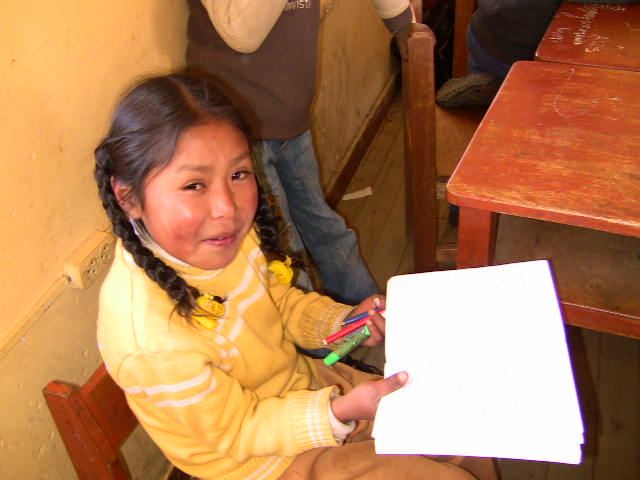
Photo: Girl with notebook, Ccotatóclla

The first week of the curriculum project was a mixed bag, as can be expected. On our third day of implementation, I went to each classroom excited to work with the kids on describing things by putting their hands in the mystery box.
There were no teachers in the classroom, although the kids were there and eager to get to work. The youngest and most energetic teacher came by to ask me to teach class in her absence since the 2nd-3rd grade teacher was desperately ill and needed her attention.
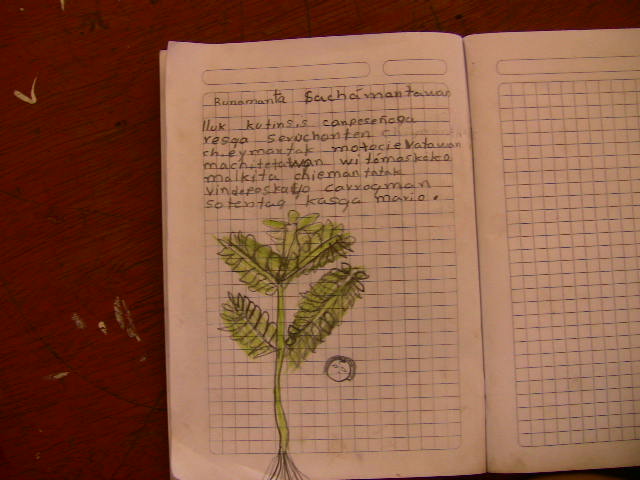
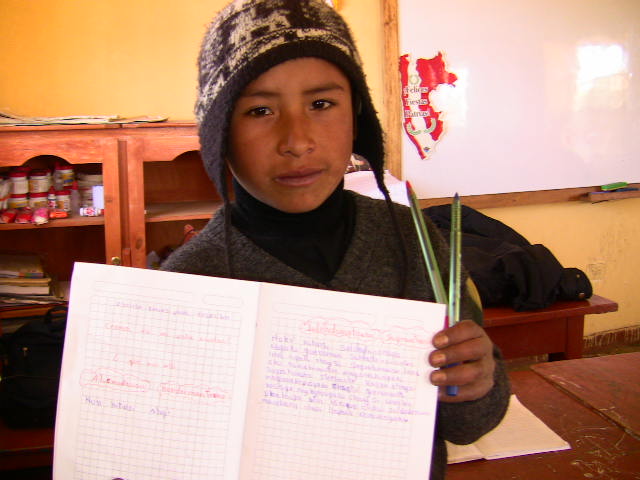
I worked in her class for an hour and managed to get the kids to write words in Quechua about the five senses and illustrate them. We did not get as far as the mystery box. Many o f the kids asked me questions in Quechua I could not answer.
I moved on to the 4th and 5th grade class and we had a lively discussion about the five senses; we then had kids put their hands in the box and describe in Quechua what they could sense with their hands. All the descriptive words went on the board along with my instructions to write a paragraph describing the living things we had discovered in the schoolyard and described via the mystery box.
The kids dutifully copied down the words and the assignment, but not a single one wrote a paragraph. I asked if they knew what a paragraph was. No one answered.
I went on to the 2nd and 3rd grade class and again was greeted with great enthusiasm; the kids loved the mystery box game. Yet again, no one wrote any descriptive sentences at the end of the game.
None of the teachers taught their classes that day.
The sick teacher recovered and returned to Cusco with her baby. The other two teachers cancelled class for the next day due to a festival they wanted to attend. We got on a bus together and rode to a town two hours away for this special religious festival.
So much for our first week of the curriculum project.
Kids in rural schools are often ready to work, while their teachers are not. It is easy to blame the teachers, but is anyone actually paying attention to them or their professional and personal needs?
Sometimes this situation reminds me of educational settings I know intimately in the US.

First week, curriculum project


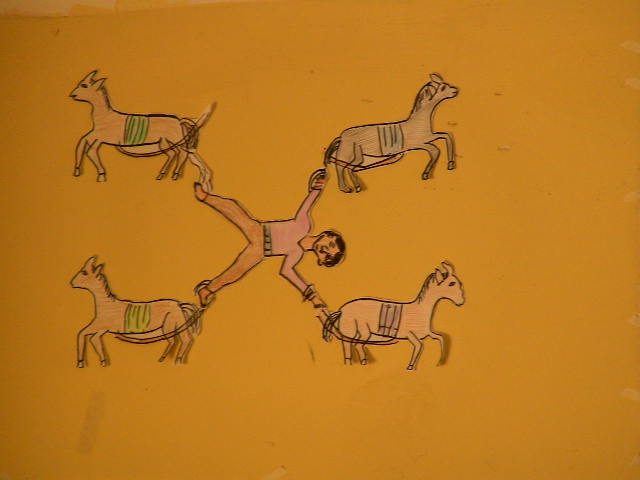
Photo: Tupac Amaru being drawn and quartered on schoolhouse wall, symbol of indigenous resistance and survival, Ccotatóclla

Written Wednesday, July 14
This was the first week of trying out the curriculum kit idea in an Andean school. Monday night the teachers and I met with about thirty parents from the community (without the benefit of translation to Quechua from my partner Martin, who arrived half an hour after the meeting due to a landslide on the road.) I presented a slide show to emphasize the following ideas:
• Quechua language and culture is endangered; less and less children are learning it and more are abandoning it as they move from country to city
• Teachers in Cusco are working together to improve curriculum materials for the teaching of Quechua in the classroom and I am here to support them as well as learn about their language
• Teachers in Boston met 100 years ago to improve materials for teaching natural sciences and created the Boston Children’s Museum, which lends learning kits to schools
Then I showed slides of selected curriculum kits that the Boston Children’s Museum lends out, including their most popular one, produced hand in hand with the Wampanoag people of Massachusetts.
We talked about creating a kit for this town that would involve kids in hands-on learning in Quechua and asked parents to help by providing wool yarn, lending tools for a school clean-up day, supporting kids’ homework by telling them stories, riddles and songs in Quechua about local plant and animal life, and showing up on the last day in traditional dress to see their kids’ presentations and be videotaped sharing their folklore and local knowledge.
Parents were shy at first, then enthusiastic and agreed to participate.
This week’s activities centered on taking all of the kids outside in groups to mark a meter square somewhere in the schoolyard with yarn and then write down observations of everything in the square. We talked in Quechua about the scientific method and antecedents in their culture for systematic observation of living things. Kids located and identified all kinds of things in the schoolyard, ranging from sheep and horse dung, beetles, medicinal plants, weeds, flowers, pieces of paper and plastic, spiders, buried rags, tufts of animal hair…In a couple of classes kids learned to measure the perimeter of a square and rectangle. All of the classes read aloud from their journals and listened to their teachers read stories and recipes related to the local plant and animal life in Quechua.
Tomorrow we will have a mystery box in which we put objects they have located outside one by one into a box with a hole in it. One kid must put a hand inside the box and describe what they think is in there; the descriptive words will go on the whiteboard and then the whole class will write descriptive sentences or paragraphs about living things in their schoolyard.

Country chats

Written July 9
It is very exciting here in the countryside today is my fourth day here and I am typing from the school office. My compadres have been very open and friendly with me and have made it clear that they want me to be comfortable and to feel like we are family. Later this afternoon I will meet with the teachers and propose a day-by-day schedule for our curriculum project to start next week. We will call a parent meeting for Monday night.
Yesterday Elena showed me her loom which is set up in the back yard and she is weaving a big heavy wool blanket from her own sheep’s wool which she dyed, spun and set up on the loom. The pattern is wide colored stripes, with large flowers and spiders. As she was weaving, I was sewing pockets on the apron I made for her. So we were just sitting there working in the morning sun and people started coming by to say hello and chat. One man was there for a long time, a man with a radio; it wasn’t until he left that I was formally introduced and I realized that he is the community president (umalliq.) I hadn’t met him last year because he was away; and Martin hadn’t met him this year because he was off campaigning for political office in the district. This morning they announced on the radio that he is an official candidate.
A few women passed through the yard in the morning on their way down to fields, I guess. Some stopped to chat.
The days have been so packed with new information that I am having trouble remembering conversations and who said what.
This morning Ignacio asked if I could start teaching English at the school and I said no, not during the day, it would supplant my main project, but I would be happy to give English lessons in the afternoon to anyone interested. He was really excited about that and said we should make it a kind of English-Quechua exchange. There is clearly a big interest in learning English here.
Yesterday with Elena and Ignacio we continued to talk about everything from household economics to birth control. They wanted to know what method we used (Ignacio translated ‘vasectomy’ in Quechua as cutting off a man’s balls, which we all chuckled about, although I was able to clarify…) Elena told me that she doesn’t want to have any more kids and her method is to “take care of herself” using the rhythm method, which she described.
I asked Elena what they do about personal hygiene and she said she puts sanitary napkins under a pile of hay and burns them, or throws them down the outhouse, which they put ashes in. She said her 10 year old daughter doesn’t know about menstruation yet and she won’t tell her until she gets her period. Tradition is to wait and tell a girl once her period starts. She says there is no reproductive education at school. She told me she has really painful periods with pain in her lower back and occasional pain in her ovaries (she thought she might have an infection in her ovary) I told her I have the same pain.
She wanted to know if North-American women feel pain during childbirth and I said yes, although some women have pain killers in the hospital. She had both of her births at home with no medical help but did have the help of her mother-in-law, with whom she gets along really well. Many women in the countryside give birth without medical help of any kind. She did have a baby girl who died or was born dead, a nice fat baby and I didn’t understand the reason for the death. She wants to have a boy but thinks it will never happen, and she won’t try again until her youngest, Yeny, is eight.
It was interesting, later during the course of the day I found out that Ignacio and Elena plan to move to Cusco in December so Sudit can go to secondary school there. Their fondest dream is for her to become a professional; perhaps a nurse; so she can maintain them in their old age. I asked about the farm and they said that she would not be able to sustain them on the farm. Everything is changing, they said, and you can’t make a living on the farm. There are increasing droughts and discussions of global warming on the radio. However, Ignacio says he prefers living in the country over the city and he says it is more relaxed.
They asked me about the Twin Towers (World Trade Center) and they were curious about how tall the buildings were, how many floors they had and what their destruction was all about. I gave a brief blow by blow account of the four planes that flew from Boston that day and explained it was a terrorist attack. Ignacio was surprised that the people who carried it out died in the attack and he wanted to know if the attack paralyzed the American economy or what it actually accomplished; I explained it was symbolic of hurting America’s economic power and also by hitting the Pentagon, the power to instigate wars. Ignacio said “your country has the most powerful military in the world, which makes you the most powerful” and I tried to explain the source of the US power; that the continent was colonized late by Europeans overflowing from their own lands and they found lots of land and resources in North America; and that people still come there for economic opportunity. He also wanted to know what the war in Iraq was all about and I explained it was a battle for control of the oil in the region, which US scientists initially discovered and then the locals wanted power over. It Is interesting to have these conversations where we can barely understand each other and we are speaking in enormous, sweeping over-simplifications and generalizations. Sometimes I wonder if the conversations are useful but in the course of the day and night it seems we are establishing something of a shared world view. They are explaining their world and their economics to me as well.
I feel they are sharing a lot of personal information about their family economics as well, and not just grilling me for my own. For example, I asked Elena if she goes to pasture her animals and she hung her head; first she said yes and then she said “I have no animals, only one sow.” It turns out that in order to buy the car a few years ago they sold all of their livestock. Then, the car failed as an investment because it was always needing repair and there was not enough income to cover the repairs, so Ignacio had to go in debt to a friend to pay for repairs, and now the car doesn’t even work. He says that his goal currently is to fix the car up and sell it. I asked if he would buy livestock again and he said it is expensive; a calf costs 500 soles; sheep are also expensive. They can’t tend animals in the city of Cusco. They had bought land there years ago and Ignacio built a home there for Sudit to have. They want to purchase land for each girl so each can have her own land and house. They want their girls to have a good education. Once the girls are through school they want to move back to their farm here in Ccotatócclla.
We talked a lot about the godparent relationship with them and with other people who stopped by. I explained that in my tradition I received godparents at baptism in my infancy. They were chosen by my parents. They didn’t have a financial relationship with me but rather a spiritual one and mostly just gave me a Bible and/or things to read, cards and gifts on my first communion etc.
Here, when I cut Yeny’s hair and gave her $20, they invested the money in a small sheep for Yeny (a hair growing animal to make up for her lost hair.) and they will sell the sheep at some point and keep investing the money on her behalf. Everyone wants to know if I will pay for Yeny’s education and bring her to live as my daughter in the states. I said I was doubtful about that but I will support her education in any ways I can.
The girls and I went out for a walk yesterday afternoon. We found some slate by the side of the road and Sudit showed me how she uses it to write people’s names. She also picked eucalyptus and another roadside plant to make tea, which we had this morning.
The telephone is run as a business from someone’s home down the road and doesn’t accept my phone card. A 10 minute call cost 13 soles (a little more than $4 US.) Ignacio’s cellphone can’t make outgoing calls unless he charges it in Cusco. The nearest other phone is in Huancarani, an hour away by bus.
There have been a lot of traffic accidents lately and I want to minimize travel on that road. Accidents due to vehicles losing their brakes, landslides and reckless driving.
My health has been good, even my stomach. I caught a cold that was going around the first hotel I stayed at but it already cleared up. Both my hosts have a virus with snot, headache and fever; so far I don’t have it.
Rituals and Education

Written July 7 and 8
I am suddenly back in Cusco for a day to attend education workshops with Martin.
An interesting moment in history has arrived: the Peruvian Ministry of Education has committed itself legally if not economically for the next seven years, to develop decentralized and native language education for all citizens (with support from UNICEF and the Canadian government.)
A small group of university educated indigenous leaders has been promoting the revitalization and respect of Andean religious, artistic and agricultural wisdom in schools. The prejudices and forces operating against this are palpable, and the official acknowledgement of this type of revitalization activity is quite unusual and seems fragile. I feel proud to be working closely with the indigenous educators who are moving so effectively within the various power structures to maintain a voice in their people’s education.
Here are some of the rituals that these teachers would like to have recognized and not stigmatized, but rather practiced at schools:
One ritual is the sharing of three coca leaves which one holds a special way and presents to a friend or blows over directly in four directions to the mountain gods. Then you chew the coca leaves and hold them in a pouch in your cheek while working.
It is typical to pour some of anything you are drinking on the ground for mother Earth as an offering.
Another ritual is the wathiya, the creation of an earth dome made of mud bricks left over from potato cultivation. Orient the door toward the wind so it will blow on the fire. Put sticks, leftover corn husks or any dried organic matter in there and light it on fire. Let it burn for about a half hour until the bricks are blackened and super hot. Throw in a lot of small potatoes and they sizzle loudly; quickly collapse the dome over the potatoes and break them up so no steam can escape. They can cook in 10-30 minutes. Then you uncover the pile and fish them out with your bare hands, peel and eat. Martin and I had a wathiya the first day in Ccotatoclla with my compadres, and the second day, another with the teachers.
When starting meals and conversations with strangers, people establish indigenous cultural/spiritual solidarity by telling ghost stories or stories of supernatural events as if they were recently and authentically experienced by the teller. I asked Martin if he takes the stories literally and he said no, they are metaphors, but the way people tell them, it would be hard for an outsider to discern that.
The hard life of the rural teacher
Many rural teachers are women with infants or toddlers in tow. One of our friend, Lourdes, had premature twins in December, and one of her twins is sickly. She keeps the sickly one with her in the classroom while she leaves the other healthier one with her mother in Cusco. The babies were in an incubator for two months. Yesterday the baby ruptured an eardrum during class, so the mother was anxious to leave for Cusco at the end of the schoolday at 1:30 pm. She had to wait for a 4:30 bus.
She, Martin and I set out on foot with our backpacks, bags and she with her baby on her back. We walked about twenty minutes down the hill to the bus, only to find several buses had passed by earlier. The only chance of getting to the city that night was to hop on the back of a potato truck and ride to the nearest big town to catch another bus. Martin and I jumped on to the bus only to find that the driver would not let our friend ride with her baby in the cab. She ended up having to hike back up to the school and stay the night, to take the next ride at dawn so her baby could see the doctor in the afternoon. She was back at work the next day… but explained to me she is on the verge of taking an unpaid leave because she can’t find a sub to take her place.
Imagine being a rural teacher: in addition to teaching class, you must also bring food for the week and cook your own meals, often while caring for your own infant. Sometimes food preparation involves getting water, although there is running water and an outhouse at this school behind the teacher’s quarters, which has a room with bed, electricity and gas burner for each teacher.
After the workshops in Cusco I headed back to the countryside without Martin.
Yesterday I got up at 4 am, bathed in a basin at Martin and Mary Carmen’s in Cusco, then Martin took me out to a taxi and I was at the San Jerónimo bus station by 5 am. I looked around for my friend, teacher Lourdes, who helped us last year with this research. She wasn’t there so I finally got on the bus that was going to the school at Mik’a (a half hour walk from Ccotatóclla) and I saved her a seat. Luckily she did make it and we had to ride separately but we got off at Mik’a and walked together up to the school. Her baby was crying on her back so halfway up we stopped outside a farm and she nursed her baby. A farm woman came out and asked if the baby was OK and she explained that the baby has an ear infection and had slept through her usual nighttime feeding, so had woken up too cranky to calm down.
Lourdes told me as we walked that it might be better for us to work at a different school because she is hoping to take a leave of absence at any moment and there are no arrangements for a sub; her two fellow teachers will have to be looking in on her class as well. The teacher who is the director of the school is only director because of seniority (she has tenure in a different district) and really hopes to retire by December. And the third teacher is just here on a yearly contract and it is her first year of teaching, although she is clearly the one with the most energy (and she herself is sick with an infection at the moment.)
I began to really doubt if it makes sense to work here at this school with so many internal obstacles among the teachers. They also clearly have a very weak relationship with the community, which was different last year when Lourdes was director.
On the other hand I have potential for a strong relationship with the community by living in one of the leaders’ homes and people have been stopping by to get to know me casually, morning and evening. The only alternative I see is to work at the school down the hill, which is much bigger. We shall see.

First day in Ccotatoclla

Written July 5
I left the hotel last night to sleep at Mary Carmen and Martin’s house so we could get up at 4:30 am to catch an early bus to Ccotatócclla. We were hoping to catch the teacher’s van from San Jerónimo but didn’t see it; however, there was a large bus that agreed to leave us right at the school.
The road is being paved so we took an alternate route, similar to last year: a rocky dirt road which wound its way up through the high mountains to this high community, which is higher than Cusco. At many points there were sheer cliffs and rockslides on the edge of the road; at one point the road was so narrow our big bus had to back up in order to let three other vehicles pass. We heard from one of the teachers on the bus that there was a serious accident in Huancarani on Sunday; six teachers were killed.
I asked Martin why teachers come from the city to work in the countryside rather than being from the country, and he said that many rural teachers actually are from the countryside but have moved to the city and choose to return to teach during the week.
The bus left at 5 and we arrived here at 7 am. My compadre Ignacio greeted us first, then Sudit (aged 10) then Elena my comadre and my little goddaughter Yeny who turned 3 on January 2, 2010. We sat in the yard and I showed them photos of my family as well as their school and other schools where we have worked; then I gave them the first present which was a photo album taken the day last year when I cut Yeny’s hair to become her godmother (chukcha rutayuq.)
Ignacio’s parents came by one by one. They looked young and energetic; his mother immediately asked me to give her my earrings, which I did. It turns out someone else has a north American godmother in the community who always comes with earrings and gifts of money. The mother quickly went off to the hills to shepherd sheep, care for pigs, cows and horses.
Sudit took me to see the chuño: freeze-dried potate which takes about two weeks to make. You start by laying the potatoes on the ground to freeze over night. They get hot in the sun, and people of all ages come and stomp on them to squeeze the juice out. This process is repeated until they are hard as rocks and ready for storage. They have to be soaked to use in soups and cooking. In the course of the day we saw chuño all over the valley and people stomping on it at random. Martin says in his town there is a special place dedicated to chuño and everyone works there at once.
Today was a special and also disorienting day because I was greeted with such friendliness by so many people and yet I understood so little of what they were saying and was able to express myself with great difficulty.
One of the first things country people have asked me, whenever given the chance, (here and in Bolivia) is always something like “When do you plant potatoes where you live?” or something related to agriculture with the specific expectation that we live as farmers as well. It always feels strange to say “I have no idea when or how potatoes are grown, or even where.” Agriculture peaked in my hometown, Williamstown, Massachusetts, in the early 1800s and farming was no longer a primary occupation for more than a handful of families by 1910. Later in the day when I was walking and not feeling so on the spot I was able to remember that we actually do grow apples, corn and squash as well as onions, tomatoes (starting them inside because of short growing season) and many other fruits and veggies in New England. My father and many friends have cultivated gardens for fun. However, subsistence farming could not be further from our experience. They wanted to know then, what do people do for work?
Here, by the way, they grow barley, potatoes, lima beans, and oats. It is too dry for corn. The first planting is around July 25. The biggest planting is September. Harvest is four months: March, April, May, June. July is a time for making adobe, construction and catching up with things you can’t do during the planting seasons.
The radio is playing now and neighbors from nearby communities send greetings to their friends who have moved one or two communities away; Elena is smiling and listening for familiar names.
The girl children challenge themselves physically from very early ages; at this moment my three year old god-daughter and her cousin Marga of the same age (who lives right next door) are busy climbing up on bricks and suspending themselves from a table and bed nearby. Earlier they busied themselves climbing in and out of a window of a new low building in the yard.
One of the things that initially impressed me about this house is even more impressive now: I asked about the origins of the fireplace and chimney design. Basically there is a traditional small clay stove which is inside a fireplace with chimney much like those in the states. I asked Ignacio about the chimney and he said it was the product of his own creativity. Later I asked his wife and daughter if Ignacio had seen a photo or model of a house with a chimney and they said no, Ignacio had dreamed of the chimney and built it based on his dream. This year, unlike last, the house is painted inside and out with elaborate painted designs – Ignacio also did that himself.
The local school is closed today. It serves first to sixth grade with two teachers (one for each two grades.) Martin and I walked down the road to the next school and talked to the director who is interested in participating in our project. They look much larger and serve elementary through high school. They were closed though there were lots of kids playing in the yard.
People on the road call out and greet us in Quechua and Spanish.

Short entry

This will be a short entry because I am leaving at 4:30 in the morning for Ccotatocclla.
I am excited because I heard from my friends Martin and Hipolito that the family I will be staying with, and their community, speaks a different kind of Quechua from Cusco Quechua. It is more like Bolivian Quechua, they say; more mixed or influenced by Aymara.
I told them the joke that the difference between a language and a dialect is an army and a navy (Max Weinreich?) In other words, whoever has power gets to claim their variety of speech is the standard.
It will be cool to learn this variety of Quechua since it may serve me better in South Bolivia later as well.

The other quick thing I want to say is that my indigenous partners in this endeavor are truly experts…experts regarding pedagogy, regarding the communication of their identity to others, regarding the structure of their language and artful ways of speaking. When I am writing proposals it often must sound like I am proposing to “bring” them something, but actually I am sure I will be learning much more from them than they from me. It would take a lifetime of work to amass the kind of expertise they have.