Category Archives: Uncategorized

Suwanaku

Sue in Suwanaku (click for stillshot)

Grad students celebrated International Mother Language Day yesterday with theater, dance, poetry and song – and cast me as the protective mother in a video of a traditional Andean courtship ritual called Suwanaku in which a young man comes to steal a woman away from her family.

The most enjoyable aspect of the day`s events was hearing everyone speak more than just a few words in their native languages. Truly beautiful – Mapudungun, Weenhayek, Aymara, Quechua, Bésiro, Yuracaré, Náhuatl, Zoque, Tojolabal, Chinanteco, Purépecha, Nasa, Ashanika – revealing the hidden identities of people who had spent the past couple of weeks together speaking Spanish.

Getting down to work

For wonderful images, see ProEIBAndes.org. I do not have a good internet connection to upload photos at this time.

(¡Manos a la obra!)

I’m well aware that my blog has not reflected my work activities at all yet. Reading it, you might think that I am exclusively here visiting friends, but that is the tip of the iceberg. For the past two weeks I’ve been working intensively at the ProEIBAndes (graduate program in Intercultural Bilingual Education) at the Universidad Mayor San Simón in Cochabamba.

Why have I delayed blogging about it? – Two reasons: blogging requires thinking in English and explaining experiences to an outside audience. As I plunge into these activities, I am thinking less and less in English and even less thinking from an outside perspective. I have been invited to participate as an insider, and I have given that my full attention.

I am honored to be treated as visiting faculty at the ProEIB. I have been given a desk and computer, a voice at meetings, a role as mentor and guest speaker, and my work is being incorporated into the curriculum. I’ve already participated in intense debates over aspects of the proposed doctoral program and about the use of in-house vs. internationally accepted formatting for citation within student work. The content of these conversations goes to the heart of positioning this program and maintaining its identity as a unique place in the Americas where indigenous people come to build an academic identity without sacrificing their cultural and linguistic values.

This past Monday, 30 new master’s students came together to introduce themselves to each other and to the program. Many wore traditional dress, played instruments, showed slides and videos of significant activities within their home communities in Bolivia, Peru, Colombia and Mexico. The students bring an impressive array of life experience. Some are recent college graduates, but most have already worked extensively as educators, interpreters, advocates, census takers, activists, spiritual guides, policy makers. There are two strands of study within the program: Intercultural Bilingual Eduaction (EIB) and Sociolinguistics.

The faculty also offers a wealth of experience. Three have been part of the program since its inception 18 years ago. Two are native speakers and accomplished linguists of Quechua and Aymara. Several have backgrounds in the social sciences, and are graduates of the program themselves; several have spoken and published internationally in their areas, although publishing is emphasized much less in the Andes than it is in the States. It is a joy and a pleasure to have lunch and conversation with these folks on a daily basis, and to read and discuss each other’s work.

For three days last week, students engaged in a process of writing their autobiographies. Yesterday I listened for several hours as each student commented on this process and what it brought to light for them. Many emotions were expressed by both men and women: rage and indignation over discrimination and violence they have experienced as native peoples in colonized/conquered terrain; indignation, humiliation, sadness. There was also laughter, pride, defiance and a sense of incredible wealth. It is this wealth of knowledge, of intuition, of heart, that is already growing within the group by being shared.

On Monday it will be my turn to speak. Students will have introductory classes in the morning with Professor Pedro Plaza on the topic of research in the social sciences. They’ll complete readings and a first stab at fieldwork in the afternoons. From 5-6:30 they’ll come to hear me speak.

Here are my topics:

Monday – an introduction to ethical relationships among researchers and rural communities

Tuesday – video and audio recording techniques for language documentation

Wednesday – research design and interviewing techniques, with hands on application (students record interviews in small groups!)

Thursday- data management, archiving and community access for the purpose of language revitalization

All of this is merely part of the preparation for the master’s program to begin.

Let the good times roll!

Nuestro mercado (guest post)

Buenos días hoy día escribo soy Maria Jolie tengo 8 años y les voy a contar como son las vendedoras aquí en Quillacollo.

Las vendedoras aquí en Quillacollo tienen sus aguayos y allí ponen sus productos que venden. Hoy compramos habas, locoto y durazno, higo también compramos pollo, mote y quesillo, frijoles. Alla en la estación hay chicos que venden libros en la estación como la Alborada y otros libros mas. Hay chicos o jóvenes que venden ropa usada de los Estados Unidos. En los Estados Unidos es muy diferente el mercado con el de los aquí de Cochabamba porque en los Estados Unidos es muy limpio y hay hartas personas que te enseñan donde ponen lo que estas buscando o los que te dan el cambio.

Our Orchard (Guest post)

IMG_20160213_142050[1]Today I woke up in Quillacollo, where I am visiting Maria del Carmen Bolivar and her mother Ruth, and her kids Samiy (age 13) and Maria Jolie (age 8). They will be by guest bloggers today and will tell you a few things about the orchard behind their house. First, I should say that when I came to Quillacollo in 1976 I rode standing in the back of a truck packed in with other teenagers coming to see the parade for the Virgin de Urqupiña. Nowadays, the tiny town of Quillacollo has been swallowed by the growing city of Cochabamba. Samiy and Maria speak Spanish, Quechua and English, having spent three years in Michigan while their Dad taught Quechua at U Mich Ann Arbor.
So, without further ado – here’s Samiy!!!!!!!!!! Good Morning everyone, I am Samiy and I am pleased to be writing in this website! I have been living in Quillacollo in my grandparent’s house for about 1 year. There are fruits that you may not know about that only bloom in Bolivia and South America. One of these “exotic” fruits that grow in our orchard is the Pacay, or the Ice cream Bean which is a yummy, sweet fruit. Another one of these fruits is the Quince, which is “membrillo” (mem-bree-yo) in Spanish. The Quinces are used for sweet, sort of sour drinks, and have a sort of furry coating. They are like apples, and come in green or yellow. We also have a dog named Iron, who I call Baby in English, and “Chiqui” (Cheek-ee), which means little in Spanish. Hey, guess what, we just ate Phisara (Pee-sa-ra) which is a food that contains Quinua (kee-nooa), Cebolla Verde, (Green Onion), Haba (Lima Beans), and Cebolla (Onion), and Quesillo (Ke-see-yo), which is farmer’s or fresh cheese.

Hi I  am Maria Jolie and I am going to talk about what we do in  our orchard. We like to sing and like to scream words. We like to do it because it’s the only place we can sing and do the things  we want. Also  we have many spaces to make a little house for a play house because I don’t have a play  house and you even can run and do alot of exercises. Once my uncle brought a real dog but I thought it was a teddy bear that was fake but it was a real dog and the habbit of my dog Iron he likes to play  he’s a playful dog he likes to eat alot of his cookies and his bones with chicken and meat.

(Associated photos are on my facebook page today-couldn’t transfer)


Endangered Skirts

Andean fashion show

People ask what I’m doing here, and I say “I’m here to work on Quechua.” The reactions are interesting and say a lot about the status of this language. A lot of people laugh or just say some version of “Why would anyone want to do that?” But many say things like “My grandmother used to wear a pollera (traditional skirt). I tried to speak Quechua with her but didn’t keep it up.Wearing traditional clothing has become synonymous with speaking an indigenous language. And when people start wearing Western clothing, they are often making a break with the past.

So – how endangered is the pollera – and what difference does it make to leave all of that behind? And is the pollera pure? Or is it already a mix of Spanish and Quechua – like the languages here in the Andes?

You can take a look for yourself at UNESCO’s interactive atlas of the world’s languages in danger. Plug in your favorite language and discover its status. Or you can ask any ten year old whether they speak Quechua at home. If they speak it at home, is it only with the grandparents? Only the mother, or also with the father? Only at home, but not at school? Only at school, but not in public meetings?

You can bet you’re in trouble if even the most passionate advocates of a language have given up on creating native language curriculum materials for formal education settings – and that is what has happened to Quechua here. If foreign linguists and tourists are the most enthusiastic learners of a language, you can bet it is settling into its grave.

I saw just one woman wearing a pollera at the Lima airport, with thousands of people bustling around. And in Cochabamba, I’ve seen lots of women in traditional dress, but few men.

What gets lost when a language dies? When this particular language dies?

We know that all individuals die and take with them their particular experience and character. When languages die there is often a loss of a particular group’s observations and interaction with their local environment. Are we depressed yet?

Not necessarily…because we are still alive, and so are big parts of many languages. It is not too late to wake up and appreciate, celebrate, enjoy what we have now. You can even revive a language that has gone to sleep – if the experience of the Wampanoag people of Massachusetts can be held up as an example. It will take some love and determination. Check out the great film “We Still Live Here” from the Boston Public Library (Roxbury Community College has a copy!)

Let’s get going with it. I’m going back to the Universidad Mayor San Simon tomorrow, to the ProEIBAndes.

p.s. You might wonder why I have conflated two languages and styles of dress in this article; women from Cochabamba tend to speak Quechua and those from La Paz, more Aymara; the women in the fashion show are from La Paz. All of them wear polleras of different styles. Aymara is even more endangered than Quechua. I have a very soft spot in my heart for Aymara as it was the first language of my Bolivian host grandfather. I have conflated it all here for the sake of simplicity – but of course the distinctions are much more interesting.

Moment of surprise

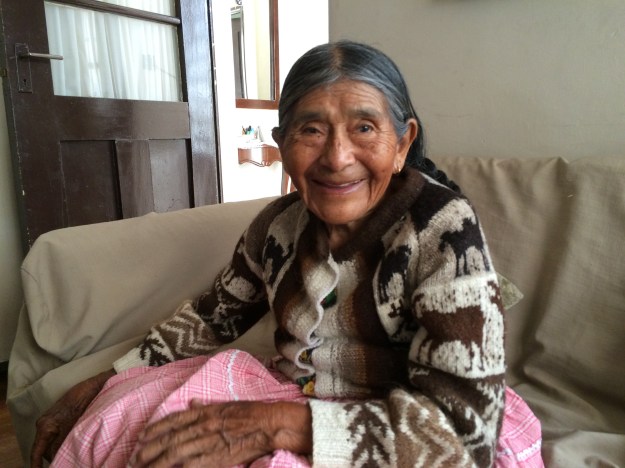
I had a moment of surprise today. It all started when I came back to the Goytia’s house and found Angela Choque sitting in the living room. Angela is now eighty-four years old and she started life as a shepherd/farmer in the highlands mining town of Oruro. As a child she broke her foot and the bone was never set properly so she hobbled throughout her life. As a young woman she converted to evangelical Christianity and soon met the charismatic pastor Jaime Goytia. When he got married to Marina, Angela offered to be their domestic servant, and she lived in their household for 30 years, cooking, cleaning, helping to raise four children, caring for their parents in their old age, and then helping to raise the grandchildren. She never married and was often in demand to help her brothers and their families as well.

Angela and I had a unique friendship the first year I lived with the Goytia family. Neither of us had ever met anyone like the other. We couldn’t have come from more different backgrounds, but we liked each other instantly and taught each other things throughout the year. Angela talked to the various household pets and to pictures of animals on the wall, and she didn’t believe that man had walked on the moon. If anyone asked her what she was cooking, she would say “It’s a dish called shut-up-and-eat” (come callado). When I was older and took her to a fancy restaurant, she announced to the wait staff loudly that she “needed to piss” (¡tengo que hacer pis!) She never stopped dressing like a shepherd and she always favored what she calls “screaming colors” (colores chillones). She’s one of the most fiercely independent women I’ve ever known.

Whenever her hands were not busy cooking or cleaning, they were spinning wool, knitting or weaving. One of the things she taught me to do was to place a stick between my toes and weave a watu, a special cord that is often used as the border of a larger weaving or festooned with pom poms and tied around a hat.

As a teenager, I noticed that Angela had a distinctive way of speaking Spanish that was heavily influenced by her native tongue which was Aymara (Quechua was her second language). She often formed words way in the back of her throat and I grew very fond of that way of speaking just because it was hers. After I returned to the US, she and I wrote to each other several times, which I knew took quite an effort for her since she had learned to read and write as an adult. When I came to visit Bolivia in 1987 with my mother, Angela had made each of us an exquisite homespun, handwoven belt with figures of birds and other animals in motion in successive squares. Today she pressed another watu into my hands as a gift. I told her that my family always thinks of her in our living room because we wrap ourselves in an afghan she crocheted.

As Miriam and I drove Angela home tonight, we left the center city and went down into the rough side of town where she lives with her nephew and his wife and their grown kids. It struck me that I feel at home in this dusty place because it is her place. Miriam and I managed to unlock the gate opposite the truck wheel vendors and walk with her back into her room.

IMG_0076

Angela Choque, age 84 at Goytia house

And then, the surprise: as we turned on her light there was a portrait of me and my family hanging above her bed, next to a few photos of the Goytia family and her own. We haven’t written to each other in nearly forty years and we’ve only seen each other for brief moments in the past couple of decades. She has moved several times. I was almost shocked to see my own face from 1976 on her wall – until I remembered her afghan in our living room and her weavings that I take everywhere with me. I guess the appreciation is mutual.

¡O Cochabamba Querida!

I’m back in the city that became my second home 40 years ago. Not only that, but for a few days I’ve been in the same household that I’ve visited so many times.

I came back expecting to feel the absence of Jaime Goytia, who passed away a year ago, but I haven’t felt it here in his house. It still seems he could walk in the door at any moment. I feel warmly embraced and surrounded by his playful spirit, his unmatched generosity and hospitality and his extraordinary sense of service. All of these qualities remain among the people he left behind: his life partner Marina, his adult children and grandchildren who came to pick me up at the airport, and even a new crop of tiny great grandchildren, one of whom (Leo, age 2) lives in the little cabin behind the main house.

Next week I’ll move to a rented room closer to the university, but this week it has been great to spend time with the Goytia family, the folks whose warmth and point of view I’ve returned to time and again throughout my life.

Today it was Marina’s 88th birthday and the house was filled with family (about 25 people strong). We ate picante mixto (tongue and chicken with chuños – dehydrated potatoes – and hot pepper sauce, rice and regular boiled potatoes as well as rice, tomato and onion salad.) The phone started ringing with congratulations starting at 9 am and didn’t let up until the night. Right now (11 pm) there is a karaoke party starting downstairs and I’d better go join in!!!!!!!

Landed in Lima

I started my Andean journey in the huge city of Lima, Peru at dawn on Monday, Feb. 1.

Lima sits on a long, narrow strip of coastal desert that is bursting with archaeological remains and modern energy. I immediately felt the thrill of being surrounded by the Spanish language and the hustle of limeños on their way to work in the morning.

Enjoyed conversing with the taxi driver from the airport – he told me that he doesn’t speak Quechua but that its most beautiful variety is spoken in his hometown of Ayacucho. I told him I’d love to go there someday since I’ve heard their beautiful music for years.

My purpose in making this trip is to spend three months working with Andean partners on the documentation and revitalization of the Quechua language.  I plan to work in three places: Cochabamba, Cusco and Chuquisaca.

Before undertaking fieldwork you have to ask permission from various authorities and making sure that your plans maximize benefit and minimize risk for the vulnerable communities you plan to visit.

That’s why I spent my first afternoon in Lima meeting with Gisela Fernandez at the Pontificia Universidad Católica of Peru. She’s the head of the new ethics committee, and they must review and approve all of their own faculty’s research projects. My connection to the PUCP is through one of my work partners, a graduate of PUCP and former faculty member there. To take a quick virtual tour of this cool campus, click here.

It was an honor to spend the afternoon with Gisela and meet some of her co-workers. She’s really sharp – a lawyer who spent the first part of her career specializing in advocating for victims of sexual violence during the 1980s. In the course of walking around campus, she took me to see the remains of the Inca Road which was recently uncovered. I was also really impressed with the architecture students’ structures which are on display right outside her office. The perfect combination of old and new that characterizes this place.

Chayamuchkani!

– estoy volviendo a la llaqta – I’m coming back!

My plane leaves for the Andes tomorrow. They say home is where the heart is – and this means I have more than one home.

As I contemplate where I am going, I remember a vivid paragraph from a favorite book called “Blanche Cleans Up” by Boston author Barbara Neely. In it she describes the thoughts of an African American woman, Blanche White, as she walks from her job cleaning the home of a wealthy client in Brookline, along past familiar landmarks into Roxbury where she feels the comfort of community. It’s a wonderful, hilarious and challenging book. http://www.goodreads.com/book/show/592956.Blanche_Cleans_Up

That same trek from Roxbury to Brookline and back is one I have made for nearly a decade. I find comfort and community in both places – and an astonishing array of barriers to authentic movement between the two worlds.

But the journey I’m about to embark on spans an even larger physical and cultural space. I’ve been going to Cochabamba for forty years now – as a teenager, young woman, mother of small children and now mother of grown children – first and always as a language learner and lover of music. My professional role now is ‘linguist’ and ‘educator’ and I am proud to wear these hats in relationship to communities for whom they make a difference in terms of breaking down barriers.

In Barbara Neely’s book, the protagonist is a woman of color who crosses many racial, cultural and class boundaries and exposes them as they arise. My own color (pink) is usually the color of privilege, and it is the one I was born with and grew into. But the color and experience of privilege is always changing in subtle ways depending on who we relate to and what we hope to be for each other. Boundaries and privilege only remain if people agree on them, and life usually calls on us to cross over both.

My first stop in Cochabamba will be in the household of the family who hosted me for a year in 1976 and who shaped my journey in unforgettable ways. In recent years various members of that family have asked where I developed such an interest in the Quechua language, and I’ve told them “In your home!” The process of distancing oneself from the ancestral languages is intense and seems to grow with time – akin to the process of ‘passing for white’ or ethnic/cultural/linguistic assimilation in the US and other places. It has to do with people deciding to ally themselves with whatever seems most fruitful for themselves and their children. Sometimes it’s a matter of survival. I don’t know if this generation is distancing itself from the grandparents’ languages more intensely now than in 1976, or if I am simply crossing that boundary more often than I could back then. I only know that it is a hot issue.

The contested value of Quechua is a major reason why it’s important to learn to speak it, and help communities to appreciate and document the language today.

Yachay Q’ipi Norte (Bringing the Wisdom Bundle Home)


Late October and early November brought several of my indigenous colleagues north on a joint speaking tour. It was truly a dream, and sometimes a bit of a nightmare, to introduce these friends to life up here. Not that they haven’t seen us all on TV and in the movies…but there are many realities that you can only get by being here.
The nightmare of course is getting a visa and traveling by air these days. Everyone seems to be treated like livestock, with potential criminal tendencies. An exaggerated fear of invaders forces us to walk through mazes in long lines, obediently removing shoes, belts and submitting to searches. All travelers must walk through immigration and customs and act calm while others go over our passports and belongings, sometimes confiscating things we were hoping to bring as gifts. My indigenous friends did this in pairs, coming from Bolivia and Perú, some leaving their hometowns for the first time ever and some, more seasoned travelers.
But the fun part was showing these folks some northern hospitality, the beautiful fall foliage, a bit of snow from the freak storm, some stunning parks and wooded places. And of course, our overabundant shopping malls and highways. We spent the first night near Warren Dunes State Park on the edge of Lake Michigan, then went to speak and listen at the University of Notre Dame in Indiana. The occasion was a Symposium on the Teaching and Learning of the Indigenous Languages of Latin America, and there were classroom teachers, endangered language specialists, curriculum developers, a handful of anthropologists and historians, all talking about supporting and learning from speakers of populous languages like Quechua and Maya, and languages with few remaining speakers, like Yurakeré.
From Notre Dame, we went on to speak at Harvard School of Education, saw the curriculum kit room at the Boston Children’s Museum, and then to Rutgers University in New Jersey. Now we are back to our scattered places of work, hoping to keep the fires of collaboration burning via the internet and future joint projects.