Category Archives: Uncategorized

Holy Week

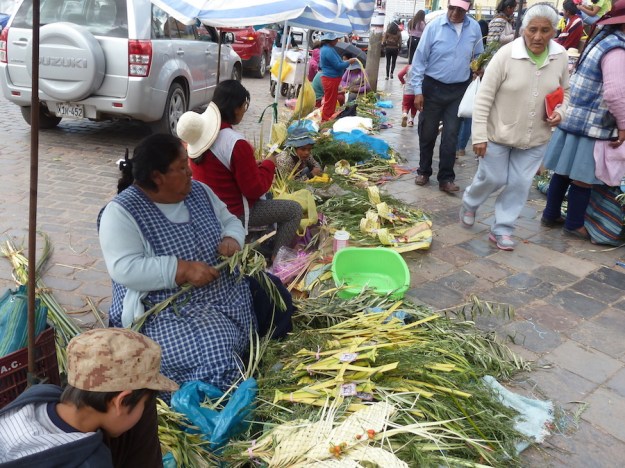
Cusco Palms

Selling palms for Palm Sunday in Cusco, photo by Judy Kalt Skeels

I’ve always been curious about the things people consider important enough to celebrate on a regular basis –  whether daily, weekly, or yearly. For example, when a person walks into a room on any given day in the cities of Bolivia or Peru, they’re expected to greet everyone in the room, with words, or often a hug and a kiss. Likewise, when they leave the room, they take leave of each person with words, a hug or kiss. Forgetting to do so implies coldness or a lack of respect. Greetings and leave-takings represent little micro rituals that tie people together. Depending on your comfort level, you can adapt and embrace these rituals and participate in them, or simply observe them from afar.

But what about the bigger rituals: the ones that happen on Sundays or holidays? I was really excited this year to be in the Andes for holy week, or Semana Santa. I knew this would be a big deal in any household. I decided it would be most fun to spend it in Chuquisaca with my friend Cristina and her family.

IMG_0702[1]

Maria Cristina and her daughter Natalie

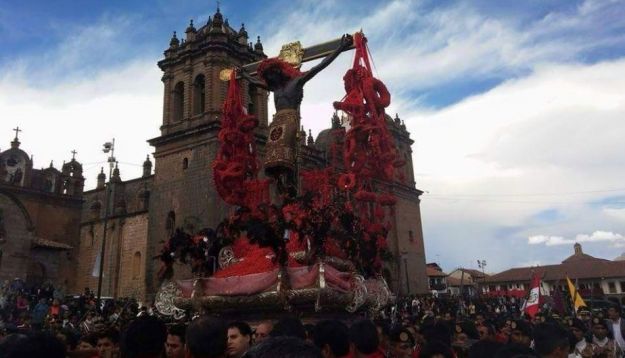
Cristina grew up in the city of Sucre, the daughter of Quechua speaking parents who were also born in the area. Her mother still wears traditional dress and both parents speak Quechua at home more than Spanish. I knew that the family was devoutly Catholic, but I had never been to church with them or attended anything more than family gatherings. I was curious to see what mix of indigenous and European traditions would be practiced. I knew that all work would be canceled for the week in Cusco, Peru, and I thought the same might be true of Bolivia, but it wasn’t. Only Good Friday (the day of Jesus’ death) was a day off.

Thursday night after work, Cristina, her husband and children and I drove to a small patch of land they own on the outskirts of the city. The soil seemed rocky and rough, but they had a good five square yards or so of tall cornstalks and they wanted us to harvest it before neighbors and birds might come to help themselves. We selected the stalks that had ears of corn that were firm on top, and cut them at the base, then separating the stalks from the ears. The stalks would be sold for cows to eat, and we brought the ears to the car, driving home in the dark. They told me that we would be fasting in the morning, and traveling the ‘way of the cross’ up the hill in commemoration of the suffering and death of Jesus.

IMG_0729[1]

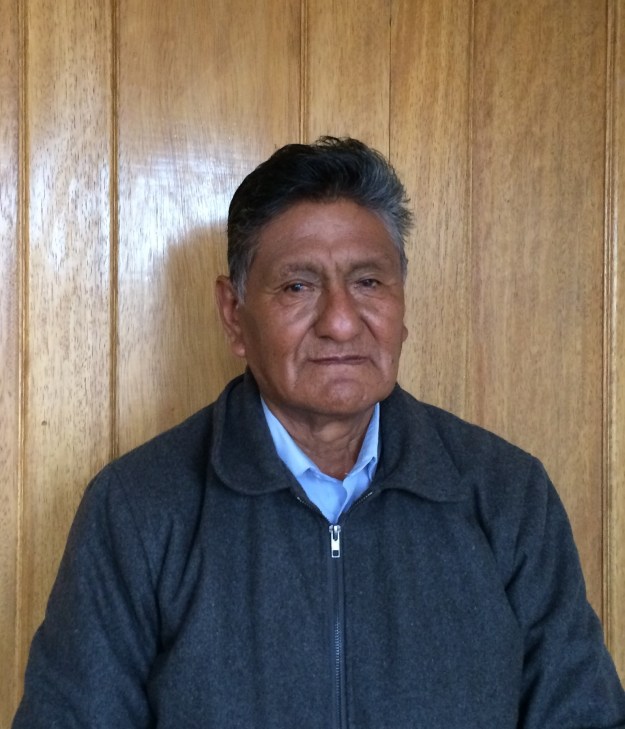
Marcelina and Aniceto, Cristina’s parents

At 4:30 in the morning, Cris and her kids and I walked up several streets until we came to the church, where thousands of people were gathering and a group of religious leaders, men and women, had begun to read prayers and meditations around cross and a rolling loudspeaker. This event, which started in the dark and cold and gradually emerged into a murky gray dawn, lasted several hours. Thousands of people of all ages followed the way of the cross up the hill, stopping at 12 stations to contemplate the events around Jesus’ death and their significance for our lives today. Frequent parallels were made between Jesus’ suffering, stumbling, anguish, torture and the difficulties and injustices of our everyday lives, addictions and deaths. There was also a great deal of emphasis on the role of Mary, Jesus’ mother and her own heartbreak and persistent love in the face of her son’s agony.

I found it challenging to focus on so much suffering while fasting in the cold and dark, far away from home. But I decided not to turn away from it or leave early, and I stuck it out until we arrived home four hours later, having met up with several of Chris’s siblings and their families who headed jubilantly back down the hill with us.

I thought about the gory movie about Jesus’ crucifixion and the sadistic and disturbing images it brought up even in the trailer. I also thought about the recent incident in Newton Massachusetts where an athletic team from a Catholic school shouted religious slurs against the Jewish community – calling them Christ killers. How ironic from a historical perspective, since Jesus himself was Jewish and was slain by the Romans. He was betrayed by his own friends as well as by religious leaders he had criticized – all in all a pretty mixed group.

IMG_0718[1]

Preparing humintas (corn cakes)

When we got back to Chris’s house, her mother and husband were already busy cooking up a storm. They told me that the tradition is to serve 12 different foods on Saturday to break the fast. Everyone in the family was expected to help prepare this meal. The most labor intensive and delicious food was made from the corn we had harvested the night before. They ground the kernels and saved the leaves to wrap humintas – the Andean version of tamales, corn mush with sugar and cheese, baked in the oven and steamed on the stove. We also ate a delicious squash and vegetable stew, spaghetti and meat dish, and three other foods I can no longer remember. I only remember being extremely full.

Easter itself was tame by comparison. Nobody got especially dressed up, but we did go to church. I don’t remember the service being especially exciting or inspiring. Cris led me into a side area to contemplate a life-sized mannequin of Jesus lying bloodied and dead in a glass coffin – which I found odd in relation to my own expectations of a Christian Easter, since I think of it as an occasion to cast aside death and contemplate spring, new life, rebirth, fertility. Afterwards we had yet another family feast, this time with grilled fish.

IMG_0737[1]

Esmeralda and Jorge grill fish for Easter

Strangely enough, in all my time in the Andes, I’ve spent more time in either Protestant or indigenous earth-centered ceremonies than in Catholic ones. I say strangely because Catholicism is the state religion here and the most widely practiced. I’m grateful to have spent this holy week with Cris and her big extended family – and most grateful for their enthusiastic sharing of every aspect of this festival.

IMG_0695[1]

Stations of the cross with traveling megaphone – dawn, Sucre

Killing Time

How does a person who is crazy about teaching and learning languages kill a little time? The people I was supposed to work with haven’t arrived yet, and a friend who is qualified to teach Quechua at the university level has been assigned instead to teach English in the public schools (which she barely knows). So, I figured, why not tag along and visit her classes? I spent yesterday afternoon teaching four English classes to about 120 middle and high school students. It was a blast. And, as always, a revelation. I guess I will never get tired of working with people who are learning a new language.

Then, this afternoon, I got to harvest corn for the first time in my life. All in all a great couple of days.

Blockade

I know I’m back in Bolivia because I was immediately greeted by a blockade. As I emerged from the airport in Sucre, I was accosted by a taxi driver who offered to take me down to the city, but at a high price due to a blockade. I waited around and determined that all the drivers were saying the same thing. So I got in the car with one of them and took a half hour drive on dirt roads with huge ruts and ditches…reminding me of work I did here in 2000 in a shanty-town on the edge of the city. Today’s blockade was carried out by residents neighboring the airport who want more city projects to help with basics such as roads and plumbing. I asked the driver if these blockades really reach their intended audience, and he said he believed that without them the officials would not pay attention.

It was a beautiful and gritty welcome back to this country – shepherds sat on the ground and schoolchildren walked by, offering advice to the taxi driver as we passed.

Spring Break

Many students and faculty in the US celebrated Spring Break last week and I did too, though it is Fall here. My husband, sister and brother-in-law came down to join me in these extraordinary places.

If you ever have a chance to travel to Cusco, I recommend you start as we did with a trip down into the Sacred Valley. This allows you to acclimatize, since most destinations in the Valley are actually lower than Cusco (11,152 feet). Macchu Picchu, the Inca town built on a mountain jutting up out of the rainforest at a mere 7,972 feet, is often referred to as one of the seven wonders of the world. We decided that Peruvian cooking counts as the eighth. (Try the ceviche mixto at El Paisa on Avenida del Sol in Cusco.)

IMG_0661[1]

Dancers at restaurant El Paisa in Cusco

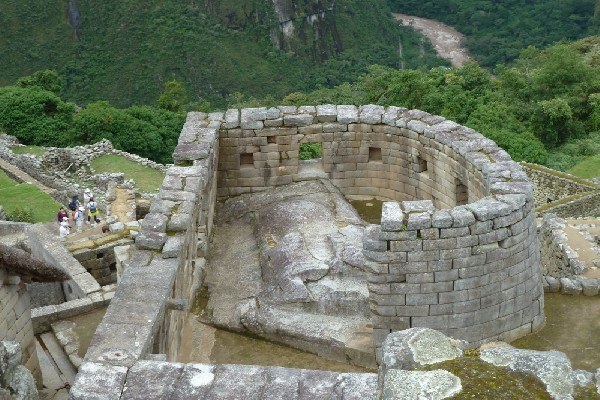
Stunning photographs don’t do these places justice. There is nothing like being surrounded by the majesty of the mountains and the endless miles of terraces and stone buildings that make them habitable and productive. The terraces prevent erosion and extreme fluctuations of temperature, capturing heat and water. The buildings serve many purposes: housing, astronomical observation, ritual life, storage, defense. In fact, these purposes were reflected in every place we visited.

In the course of returning to the city, we visited the salt mines that served donkey trains shuttling silver from Bolivia to destinations in Lima and then Europe. We also saw the pre-Incan concentric  circular terraces of Moray.

Nowadays in the Sacred Valley and even parts of Cusco, the primary economic activity is tourism. We were concerned that we might be rained out of the valley, and yet I was certain that Cusco alone would be worth the visit – Saqsaywaman and related wonders are within walking distance of the center of town.

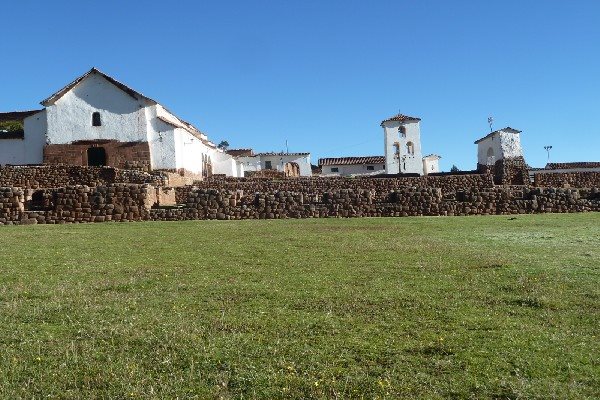
I saw several things I’d missed on previous visits, including the extensive ruins at Chincheros which I had neglected by not walking beyond the church yard. An indigenous teenage boy who tried to sell us keychains in a courtyard of those ruins ended up giving us a fascinating recitation of everything he knew about the Incas and their descendants in the valley. He told us about the primary ‘products’ of each town: weaving, potatoes, and in the case of Macchu Picchu: young beautiful women. According to his grandfather, the Incas did not marry these women because they were not good weavers – only good looking. Needless to say, Chincheros is known for its weavings.

Chinchero ruins below church

Tip of the iceberg – top part of Inca ruins under Catholic church in Chincheros – photo by Judy Kalt Skeels


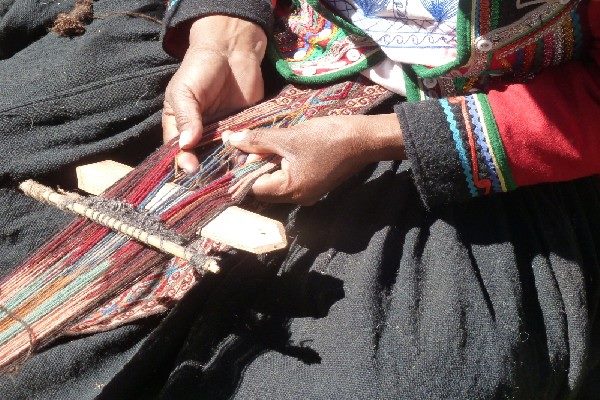
Our taxi driver told us that he would take us to a place in Chincheros where we could dress up in traditional ponchos, have our pictures taken and be sung to in Quechua. I had something even better in mind, and requested that he take us to the Center for Traditional Textiles, an NGO founded by Nilda Callañaupa which also has an outlet on the Avenida del Sol in Cusco. There we saw everything from washing, spinning and dying raw wool, to setting up the warp and weaving on a backstrap loom. This organization has had great success with cataloguing and regaining the prestige of traditional weaving techniques and patterns while spurring economic growth and new designs. If only we could be so successful with endangered languages! Once again we were amazed at the creativity and resourcefulness of Andean people in ancient and modern times.

Chinchero weaver

Weaver at the Center for Traditional Textiles, Chincheros, photo by Judy Kalt Skeels

We finished the week with four more days exploring in and around Cusco. According to an indigenous friend, the Catholic church, Peruvian state and private enterprises have appropriated and built on top of nearly everything created by indigenous people – he complained bitterly that a fraction of this wealth makes it back to Quechua-speaking communities in the countryside. Time cannot be rolled back, but we all wonder how these communities can take their rightful place as they move forward.

Singing garbage trucks

We were awakened at 6:30 AM  by loud music blasting from a megaphone on a truck. I was puzzled – could it be a political campaign?  Anywhere else, blasting music so early would count against you! No, it turned out it was the garbage truck.  In the next town over, another garbage truck circulated at night, advertising its presence with traditional  songs.  If you google Peruvian garbage truck, you’ll find a variety of  similar  videos and descriptions. The soundtrack is often interrupted by a cheerful announcement urging neighbors and friends to bring their garbage now rather than later. Litter is a huge problem here, and singing garbage trucks are part of the solution.

Sacred Valley

I’ve been taking a break from work this week and following the course of the Vilcanota River  through the Sacred valley of the Incas.  We started in the market town of  Pisac    and wandered through the amazing terraced  landscape where the townspeople’s ancestors perfected the art of cultivation at different altitudes. The next day we were on to Urubamba and then Ollantaytambo. Today we hiked to the Inti Punku (Sun Gate) and then descended to spectacular Machu Picchu – if you haven’t seen it, put it on your itinerary!

All of these places display an extraordinary dialogue between humans and nature. Where does the mountain end and the stonework begin?

Against linguistic extractivism

Rufino Chuquimamani2

Rufino Chuquimamani – Quechua expert and author, invited comentarista at Monday’s talk

I’ve found myself declaring lately that I am trying to practice an alternative to linguistic extractivism – but what does that mean? I think I coined the term.

According to IGI-global.com, extractivism is

“A term of growing use in Latin America academia and social movements to describe economic activities that remove of large amounts of a nation’s natural commons for sale on the world market …”

I personally associate extractivism with the explosion of mining activities that endanger vulnerable communities in the Andes. Resources are taken out of communities in one direction, leaving waste products behind and moving the good stuff for consumption elsewhere. Similarly, linguists and anthropologists are notorious for conducting work that enriches their academic careers but never finds its way back to communities of origin.

An alternative practice is more like traditional agriculture, which is cyclical rather than linear. In this practice, communities themselves take care to return what they have taken from the earth back to where it is needed, with value added.

There are parallels in the practice of linguistic research among indigenous communities. We have a choice to make — are we simply going to mine these communities for what they have to offer linguistic science? Or are we going to take our place as honorary members of the communities when invited, returning results in ways that enrich their identities and allow for more dynamic teaching and use of the native languages?

It has been such a joy and privilege to spend the past six weeks in a phase of returning results. Taking the time to return results offers a break from the pressure off data collection so I can listen more carefully and simply observe what the needs are locally. There will be time soon enough to resume fieldwork, but it’s really enjoyable to see the results savored by people for whom they make a difference.

That was my experience on Sunday and Monday here as I gave talks to teachers and language rights activists in Cusco. There are currently very few viable university connections between local linguists and educators, and the organizations that are carrying out teacher preparation are up to their eyeballs in work. So I hired a pair of private consultants to help me put on two events here. One took place at the Asociación Pukllasunchis, a hub of intercultural education that mostly serves elites in the city but also runs a terrific radio program in the countryside. The other was at a museum run by the Ministry of Culture.

People actually got excited about grammar at these talks! They got excited because they saw for themselves what a complex and intricate mental system their local children have mastered by the time they get to school. Now they’re begging me to come back and offer the talk again in April to the team that helps plan Quechua language teaching content. Glad to see this work come off the bookshelf and into a useful place.

Hosts in Cbba

For a few weeks in February, I rented a room from the Arnez family who live just 6 blocks from the University. It was so pleasant to walk to work in the morning, and to eat Tanya’s home-cooked meals at night! I found this family through an organization called Sustainable Bolivia. Very kind folks  – the grandfather, Esteban, runs a small storefront at the house and his son, also Esteban, drives a large bus to and from their original hometown of Punata, where Quechua is spoken. Tanya tells me that she and her father-in-law speak Quechua ‘but not the pure kind’ – a typical refrain of people from Cochabamba who are aware that their language is heavily mixed with Spanish.

Altiplano diaries

Bolivia is home to ‘el altiplano’, the high plain, sometimes known as the table top of the world. It extends for many miles from Southern Peru to Southern Bolivia at an average altitude of 13000 feet above sea level. I’m writing this as I sit in the airport at an altitude of 13353 feet. Travelers and athletes from lower altitudes often need oxygen at this altitude; digestion and metabolism is also slower. I have usually managed by drinking mate de coca or coca leaf tea in what used to be a very small, pink airport building. Today I am sitting in a brand new modern building and haven’t stopped in for tea yet. Having spent the last month in a valley at 8400 feet above sea level, I am slightly better acclimatized, but I do feel a little dizzy.

I’m sure my kids remember the graphic lesson in what happens to fluids when transitioning from one extreme altitude to another: a bottle of soda bulged and overflowed at the high altitude, and practically imploded when returning to sea level. Hmmm, this is what happens at the cellular level too, which is why some people get a massive headache and have heart palpitations at high altitudes. Tea time!

Flamingos

I will never forget seeing a flock of iridescent orange-pink flamingos at dusk on the banks of a dark slate colored Lake Poopo. That was on a train ride across the altiplano in 1976. At that time, a group of people called the Uru-Chipaya lived around the lake and survived primarily by fishing. The name of their language is also related to the name of the nearby mining town of Oruro.

Some time in the 1990s, a consortium of Bolivians and foreign multinationals built a gas pipeline that runs the length of the altiplano, transporting natural gas. Around the turn of the millennium, an oil spill poisoned the lake, and now I hear it has dried up entirely – recent news reports confirm this, although the article attached here shows the return of some flamingos after rain fell in January. http://mashable.com/2016/01/25/bolivia-largest-lake-desert/#.bNYlUSm6aqc

A couple of young women who just started at ProEIB Andes, Delicia and Jhandira, conducted an ethnographic study in nearby communities, trying to discover the fate of the Uru-Chipaya people and their language. They reported that the language is no longer being spoken except by the elderly, and that people who left the Lake region have begun speaking Quechua and Spanish instead. A handful of skinny books including sociolinguistic studies and collections of Uru-Chipaya songs and stories is on display at the ProEIB Andes.IMG_0403[1]

Lights, camera, action.

Last week was my chance to work closely with the 30 new grad students. My favorite evening was Wednesday  as it was totally hands on. I gave each small group of students some kind of recording device, blank media, power source, tripod or alternative mount, an equipment checklist, a consent form, a questionaire and a comic strip. First, they had to figure out how to make their devices work and optimize them for voice recording according to the latest language documentation standards. Then, they set about asking one of their members for permission to record, gathering biographical information and eliciting a story from the comic strip. Finally, each group turned everything off and gave it back with a brief report on their session.

The most popular accessory by far was the one pictured here called the Action Pod. There was endless speculation about its uses… go figure. Click to see Action Pod

A few reactions to the week´s activities – (translated from Spanish)

“At first our group thought using the (zoom h2n audio) recorder was too complex, but upon reading the manual we found we could manage it easily”

“I learned that we need to take ethics into account when gathering and publishing data”

“What I really want to know is, how do you revive an endangered language?”

“As native speakers we need to know how to document our languages in order to conserve and spread their use.”

“I wish we could have learned more about how to create databases, this is a gap in my preparation.”

“Come visit my homeland, you are always welcome.”